‘Self Arranged’: The Online Matrimonial Mantra by Tara Kaushal

April 2013: How urban Indians use matrimonial sites has changed, and what these changes mean.

I recently met an old friend, and we got chatting about how he met the person he had married. “We met online,” he said. “Don’t tell me you met on Shaadi.com,” I exclaimed with my usual disdain of arranged marriages. “Actually, we did… I saw her profile, liked what she said about wanting an equal partner and being feminist, paid three and a half thousand to get her number, and called her.” Rajiv and Niharika dated for two years before marrying last November.

Several of my other friends, all around 30, are on online matrimonial sites. All of them: A) claim to be coerced in to registering themselves by friends or family. (“It keeps mum and dad off my back,” one said. Another’s friend made his account, and even shortlisted a few interesting prospects.) And B), will only grudgingly admit it. Because, for a generation that scoffs at the idea of arranged marriage as seeing each other over chai and samosas with hovering parents, the very idea of meeting someone on a matrimonial site is problematic, as an idea.

Increasingly, though, I realise that, to a certain section of urban India, the function and utility of these sites is changing. It seems that being on an online matrimonial site only indicates that one is on the lookout for a serious relationship, and most of my friends who’ve met people through them have dated for a while before settling down—or not. And by filtering matches according to the parameters people are looking for—age, religion, etc—there’s a system-generated adherence to social mores. For some, these ‘self arranged’ matches have the best of both worlds—unlike in real life, where love can happen inter-caste/creed/religion (heaven forbid!), the people one meets here check the right boxes straight off. And then one gets to date a person with similar serious intentions, but not necessarily ready to go straight from keyboard down the isle. “From the start, you know the meeting is not about friendship, which changes the equation of the interaction from the beginning,” says 31-year-old Sangeetha, who married someone she met online.

Self arranged the online matrimonial mantra ed.jpg

In other countries, this function would be served by online dating sites. There are a whole host—from those for those looking for casual flings, threesomes and swingers even, to those for those with serious intentions. But simply calling them ‘dating’ websites would make them too Western in the Indian scheme of things; the idea that marriage is the ultimate agenda makes them easier to for families to palate.

What Does this Environment Mean for Women?

On one level, online dating can be empowering for women. Aside from the photograph, a great deal of the initial communication is online, allowing the development of a personality-based connection beyond pressures on appearances. “Meeting online allows two disparate people, who would never exchange numbers at a party, to explore a deeper connect,” says a Jordyn Steig, who met his wife Pamela through Facebook. 

Does being allowed to ‘self arrange’ empower women, giving them some degree of freedom to choose their own partners from within a family-approved shortlist? Not really. For the most part, women aren’t allowed to negotiate this world unchaperoned either. Fathers and mothers remain the gatekeepers, dis/approving potential partners. And, unfortunately, the gender inequality of conventional dating rules still applies. “You can’t ask for guys’ numbers; it’s considered too forward,” says a 30-year-old architect. “You can’t be too comfortable or proactive. Guys will be more forthcoming, and the onus remains on them to make the first moves.” The men will—and can—write to a whole host of women, hoping that someone will write back.

Interesting, for an environment that, you would think, demands high levels of trust, Indian matrimonial sites are chock-full of players, and, worst still, scam artists. Players troll matrimonial sites, looking for the gullible and the desperate, with a purely sexual agenda. A Mumbai-based friend has encountered several of those. One wonders at the desperation of the Indian male—in the early days of Couch Surfing, I’ve heard stories of how potbellied sickos would appear for meetings, waiting for the foreign women to get drunk and loose. Are there not enough places for people with sex on their minds to connect with others similarly inclined? My personal experience on this front is a little dated, but I'm sure the internet continues to offer many such avenues.

On serious dating websites abroad, one tends to encounter more scam artists than players. My mother, a young widow, who I bullied onto these sites in India and Australia (where she lives), encountered a fresh-faced 50-year-old in another Australian city, almost too good to be true. In English that raised several red flags, he told her he was soon leaving for Central Africa for a mining contract. He’d be too busy to call her before he left; would she be okay if they spoke once he reached, of all places, Nigeria (another red flag)! I was certain he had never been in Australia—and sure enough, one phone call and my mother knew too. “He’s black, Tara*,” she said, not being racist but simply stating that he wasn’t what he seemed. Mum stopped responding to his plaintive emails, so the expected ‘I’m in trouble, I need you to wire me some money urgently’ email never came. The site soon sent her an alert about this profile. (Incidentally, my friend never managed to get the administrators of an Indian site to take her complaint about a fellow user—with a misrepresentative profile and sex on his mind—taken seriously, and he continues to hold an active profile.)

‘Matrimonial’ sites allow urban Indians to bridge traditional and modern worlds, one click at a time, but continue to bear the unfortunate baggage of gender inequality. With time, perhaps, our culture will evolve beyond needing the subterfuge of dating under the guise of seeking an arranged match; and our players will find enough willing and sexually liberated playmates in appropriate places, without needing to feign serious intent.


An edited version of this column appeared in Governance Now in April 2013.

The Battle for My Surname by Tara Kaushal

April 2013: Why is retaining my surname after marriage such a constant fight?

I am fiercely protective of my name, and would not change it for the world. (Thanks to a bullying ex-husband, I’ve been there, done that, got the passport, thank you very much.) Nothing but ‘Tara* Kaushal’ feels like my name, not then, and even not now, in a very happy second marriage. Besides, I have a strong feminist agenda, and a whole score of reasons why I believe it was a mistake of youth to hyphenate the first time around and why I won’t do it again.

Anyway, the issue here is not why I want to retain my surname after marriage, but the fact that I do. And in the little time that I’ve been married, I have realised just how ingrained the patriarchal assumption of an automatic name-change is in our society and government systems.

My passport was a whole different level of complicated. Well after my divorce and even a few months in to my second marriage, for want of a permanent address, my passport stayed unupdated and said I was still married to my first husband, hyphenated surname et al. Now, in Maharashtra, marrying a Sahil Mane automatically makes me a Mrs Tara* Sahil Mane, adding the insult of his first name as my middle name to the injury of his surname automatically replacing mine. So, when it came time to update my passport, I visited the passport office to figure out how I could bypass this. The blank stares that greeted my preposterous request led me in to the arms of an agent.

Much research later, he said I would need an affidavit that went something like this: ‘I, Tara* <insert hyphenated surname>, upon divorce and remarriage, would not like to change my name to Tara* Sahil Mane but would like to revert to my maiden name.’ I bullied and blustered my way through the first few stages of the passport interviews, flashing my affidavit at confused officials. The last lady asked for a copy of the ad I should have placed in a national newspaper declaring my changed name, but accepted my protests that I was just choosing to retain the name on my birth certificate, why would I need an ad? It must have been a confusing, unusual case, because my passport came four months later.

Armed with this passport, getting my lost pan card reissued was simpler. A friendly, gentle Mr Deshpande with a foot in the retirement door asked if I was one of those ‘crusader types’. Though I don’t know the language, he even showed me a Marathi newspaper with an article about some feminist campaign, and insisted I take a photocopy to keep up with the actions of my comrades in arms.

The effort towards a married-with-my-original name passport has made life infinitely easier. Now, every time I have to insist on the use of my name, I simply have to whip out my passport. I even carry a copy around in my wallet (sarcasm intended). What’s scary is how often I’ve had to use this tactic. Adding my name on to Sahil’s membership at a local gymkhana is a fight I'm still fighting. Apparently, its systems are not built to accept different surnames for married couples with the same membership number. “Aapko feminism karna hai toh dono naam kyon nahi rakh lete? It will be easier,” advised this helpful clerk when I baulked at the looming battle with bureaucracy.

The battle for my surname ed.jpg

Then, there are the social reactions that I and other women who have different surnames from their husbands encounter. When booking tickets on a sleeper bus to Goa, I told the agent I’d like the seats together as I would be travelling with my husband. He filled in my name, then assumed my husband’s name was Kaushal. When I said it wasn’t, his snigger said it all. (And when he realised that we don’t share a surname and he is younger, that’s it, his image of me as a lying woman of questionable character was complete.) I also deal with sniggering clerks when we try to check in to smaller hotels. The social censure doesn’t faze me; Sahil and I lived together for years before we married, and one develops a bit of a thick skin. Fortunately, he laughs off the mail addressed to ‘Mr & Mrs Kaushal’ that occasionally lands up in our letterbox, as he does friends’ teasingly calling him ‘Mr Kaushal’ when I’m hogging the limelight. These may not be easy things for a less secure man to accept.

The sign of a mature democracy is the way it treats its women. Are we cattle, to be possessed and passed on from one male to another, ensconced in a patriarchal cultural and governance system; or are we treated as individuals entitled to make our own choices? That the default is patriarchal is bad enough, it is infinitely worse that one has to struggle against so much to make customised choices against the norm. I always choose to wear the name I grew up with… Except when dealing with traffic cops, where I allow myself the small luxury of donning Sahil’s Maharashtrian surname. The battle wages.


An edited version of this column appeared in Governance Now in April 2013.

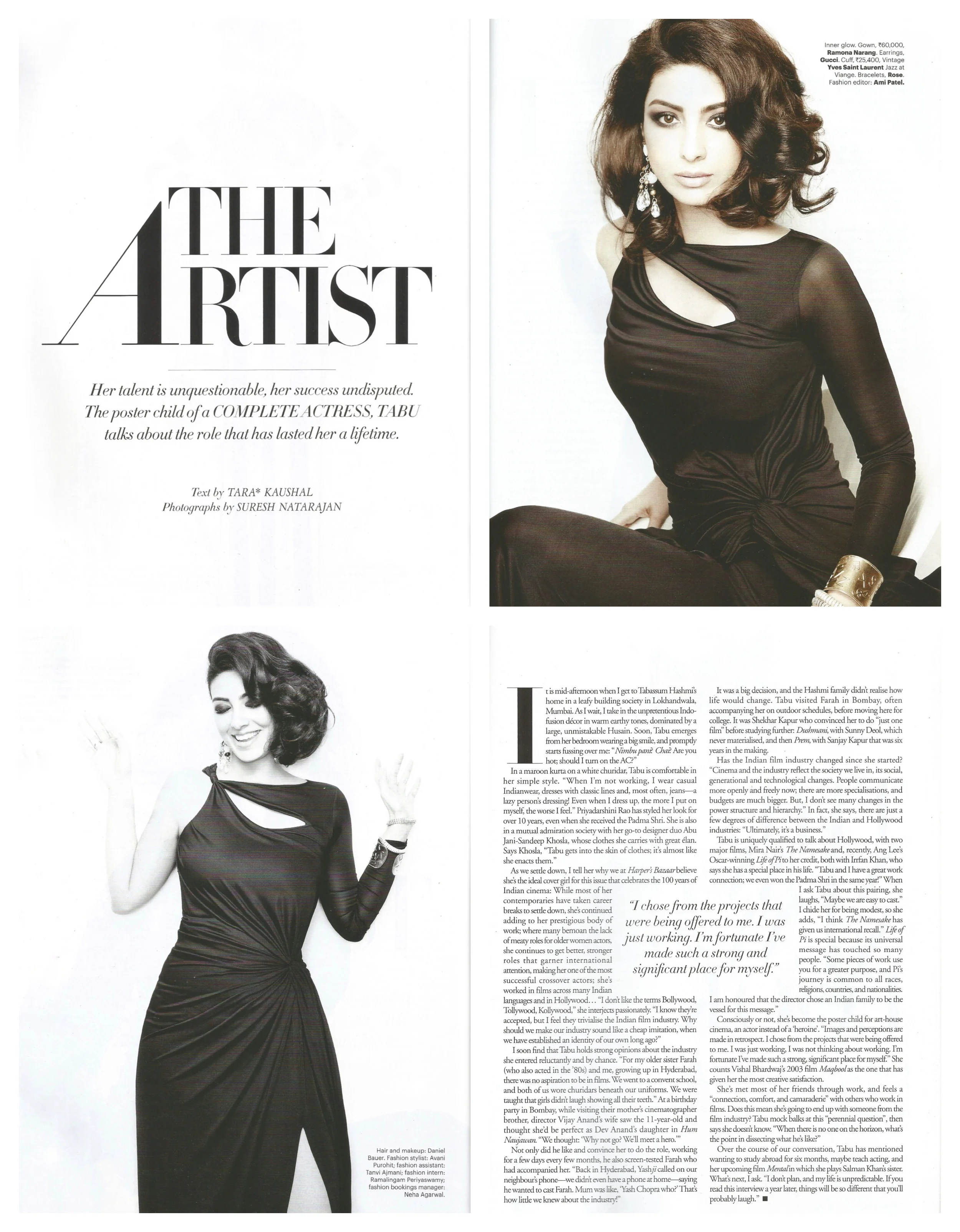
Interview: Tabu by Tara Kaushal

April 2013: Tabu embodies the best of the Indian film industry. Here she talks about her long and unexpected journey from Hyderabad to Hollywood.

The cover of Harper's Bazaar.

The cover of Harper's Bazaar.

It is mid-afternoon when I get to Tabassum Hashmi’s home in a leafy building society in Lokhandwala, Mumbai. As I wait, I take in the unpretentious Indo-fusion decor in warm earthy tones, dominated by a large, unmistakable Husain. Soon, Tabu emerges from her bedroom wearing a big smile, and promptly starts fussing over me: "Nimbu pani? Chai? Are you hot; should I turn on the AC?"

In a maroon kurta on a white churidar, Tabu is comfortable in her simple style. “When I’m not working, I wear casual Indians, dresses with classic lines and, most often, jeans—a lazy person’s dressing! Even when I dress up, the more I put on myself, the worse I feel.” Priyadarshini Rao has styled her look for over 10 years, even when she received the Padma Shri. She is also in a mutual admiration society with her go-to designer duo Abu-Sandeep, whose clothes she carries with great élan. Says Sandeep, “Tabu gets in to the skin of clothes; it’s almost like she enacts them.”

As we settle down, I tell her why we at Harper’s Bazaar believe she’s the ideal cover girl for this issue that celebrates a hundred years of Indian cinema: while most of her contemporaries have taken career breaks to settle down, she’s continued adding to her prestigious body of work; where many bemoan the lack of meaty roles for older women actors, she continues to get better, stronger roles that garner international attention, making her one of the most successful crossover actors; she’s worked in films across many Indian languages and in Hollywood, apart from Bollywood… “I don’t like the terms Bollywood, Tollywood, Kollywood,” she interjects passionately. “I know they’re accepted, even in the dictionary, But I feel they trivialise the Indian film industry. Why should we make our industry sound like a cheap imitation of Hollywood, when we have long before established an identity of our own?”

Point taken. I will soon find that Tabu holds strong opinions about the industry she entered reluctantly and by chance. “For my older sister, ['80s leading lady] Farah and I, growing up in a typical household in Hyderabad, there was no aspiration to be in films. We went to convent school, and both of us wore churidars beneath our uniforms. We were taught that girls didn’t laugh showing all their teeth.” At a birthday party in Bombay, while visiting their mum’s cinematographer brother, director Vijay Anand’s wife saw the 11-year-old and thought she’d be perfect as Dev Anand’s daughter in Hum Naujawan. “We thought: ‘Why not go? We’ll get to meet a hero.’”

Not only did he like and convince her to do the role, working for a few days every few months, he also screen tested Farah who had accompanied her. “Back in Hyderabad, Yashji called on our neighbour’s phone—we didn’t even have a phone at home—saying he wanted to cast Farah. Mum was like, ‘Yash Chopra who?’ That’s how little we knew about the industry!”

The Harper's Bazaar cover story.

The Harper's Bazaar cover story.

It was a big decision, and the Hashmi family didn’t realise how life would change. Tabu visited Farah in Bombay, often accompanying her on outdoor schedules, before moving here for college. It was Shekhar Kapur who convinced her to do “just one film” before studying further: Dushmani, with Sunny Deol, which never materialised, and then Prem, with Sanjay Kapur that was six years in the making. “If films hadn’t happened, don't think I would have been a professional. I’d be married to a nice boy in Hyderabad or London, with two-three kids,” she laughs.  

Has the Indian film industry changed since she started? “Cinema and the industry reflect the society we live in, and the social, generational and technological changes that are in all walks of life. People communicate more openly and freely now; there are more specialisations and designations; and budgets are much bigger. But, I don't see many changes in the power structure and hierarchy.” In fact, she says, there are just a few degrees of difference between the Indian and Hollywood industries: “Ultimately, it’s a business.” It is with this that she brushes away a question about film dynasties. “In every industry, there are people who run family businesses, so too in films. Also, if you’ve grown up in a family that acts or directs, it’s in your nature and nurture. Doctors’ children often become doctors; my mother is a teacher like my grandparents, I might have been one too—it’s okay if people want to carry on their families’ legacies. I don’t see it as a problem and don’t judge it. Ultimately, it is your personal journey, and only work will become your identity.”

Tabu is uniquely qualified to talk about Hollywood, with two major films, Mira Nair’s The Namesake and, recently, Ang Lee’s Oscar-winning Life of Pi to her credit, both with Irrfan Khan, who says she has a special place in his life. “Tabu and I have a great work connection; we even won the Padma Shri in the same year!” When I ask Tabu about this pairing, she laughs, “Maybe we are easy to cast.” I chide her for being modest, so she adds, “I think The Namesake has given us international recall.” Life of Pi is special because its universal message has touched so many people. “Some pieces of work use you for a greater purpose that consumes you. Every human being has existentialist questions, and Pi’s journey is common to all races, religions, countries and nationalities. I am honoured that the director chose an Indian family to be the vessel for this message.”

Consciously or not, she’s become the poster child for art-house cinema, an actor instead of a ‘heroine’. “Images and perceptions are made in retrospect. I chose from the projects that were being offered to me. I was just working, I was not thinking about working. I’m fortunate I’ve made such a strong and significant place for myself.” She wishes she had a life plan, but has long since realised that going with the flow, following her heart is the only way for her. “I live life from my feelings, and happiness comes from personal satisfaction from my work, love and respect from my peers and audiences, my relationships, and my friends.” She counts Vishal Bhardwaj’s 2003 film Maqbool as the one that has given her the most creative satisfaction.

She’s met most of her friends through work, and feels a “connection, comfort and camaraderie”, with others who work in films. And this begs the question: does this mean she’s going to end up with someone from the film industry?

Tabu mock balks at this “perennial question”, then says she doesn’t know. “When there is no one on the horizon, what’s the point in dissecting what he’s like, which industry he’s from? What can I say about a relationship, especially if it doesn’t exist!” Does she aspire to children? “That’s very hypothetical,” she exclaims. “There’s no man, no marriage, where’s the question of children...!”

Over the course of our conversation, Tabu has mentioned wanting to study abroad for six months, maybe teach acting, and her upcoming film Mental in which she plays Salman Khan’s sister. "What’s next?" I ask as I prepare to wrap up. “I don’t plan, and my life is unpredictable. If you read this interview a year later, things will be so different that you’ll probably laugh.” 


An edited version of this interview was the cover story of Harper's Bazaar in April 2013.

Life, Interrupted: Sanjay Dutt by Tara Kaushal

March 2013: Why are we feeling bad for Sanjay Dutt?

I was surrounded by film folk, art directing a television commercial, when news broke of Sanjay Dutt’s sentencing by the Supreme Court. Within four weeks of March 21st, Dutt has to return to jail to serve the remainder of his five-year term (reduced from six), of which he has already served 18 months.

The reactions on the set were mixed: someone called and commiserated with a director friend, whose film requires only five more days of Dutt’s time to complete (according to some reports, Bollywood has Rs 250 crores riding on him); one-time fans bemoaned the fall of a once-bright star; others said he deserved it, and that justice was finally served. My Facebook news feed has been swamped with a regurgitation of archival articles and current news about the case, and, in most cases (saving biased Twitter talk by his colleagues in Bollywood), the feeling is ‘finally!’

I do not dismiss the overwhelming sentiment: to see it in black and white, surely, Dutt broke the law and, like other citizens, deserves to be punished. At first glance, there is validation in the fact that the best lawyers, and the combined might of political clout, fame and wealth have not been able to prevent this mighty from falling, albeit not as far as he would have had the TADA case stuck. (Though the Terrorist And Destructive Activities case against him was dropped in 2006, questions linger about why he, and he alone among the others chargesheeted, escaped, especially since he is known to have famously confessed, “Because I have Muslim blood in my veins, I could not bear what was happening in the city.” Also, he’s got away with a five-year jail term, the absolute minimum the law prescribes for possessing illegal arms under the Arms Act.)

So, the fact that at least some punishment has finally come Dutt’s way should be cause for celebration. Then why this little, niggling tinge of grey sympathy? And I am not alone. Not counting Justice Foot-in-Mouth Katju’s laughable open letter appealing to the governor for Dutt’s pardon, I notice other nuanced reactions: “My heart goes out to Sanju Baba, his wife and kids—fifth jail sentence in 20 years,” is a sensitive friend’s status update.

Nothing is more telling of the passage of time than the images accompanying the news stories, contrasting the long-haired hulk being arrested in April ’93 with the ungracefully aging man Sanjay Dutt is today. He was 33 then, a brash have-it-all who did some seriously stupid and illegal things. Twenty years later, he’s almost five years into his third marriage, with toddler twins. In three and a half years, he will emerge from jail pushing 58, and it is unlikely that he will ever be able to reignite the embers of his already dying career.

Hypothetically, let’s consider what the past 20 years would have been like for Dutt, were we living in a parallel universe where the Indian justice system was swift and efficient, and one couldn’t exploit its tardiness by influence. Assuming a year-long trial from beginning to last appeal (boy, I’m optimistic, aren’t I?), plus a six-year sentence, he’d have been out in seven years from ’93, in the year 2000. At 40, it may have been easier to pick up the scraps of his life and salvage his career. Today, 13 years later, (to stretch metaphors) it would have all been water under the bridge and water would have found its level.

There is a reason Christian mythology describes the state of ‘limbo’ as almost akin to hell; in colloquial parlance, it refers to being stuck until another action happens. Twenty years is a long time to languish in debilitating limbo. Can you imagine the stressful anticipation of not knowing if or when the other shoe would drop; and then there have been courts, lawyers, police, arrests and bureaucracy to grapple with at every step of the way. My mother likens this situation to my father’s unsuccessful tryst with chemotherapy, that didn’t save his life and instead reduced its quality. “Just because you have the means to do it, doesn’t mean it’s better than the alternative,” she says. As with dad’s chemo, with 20/20 hindsight one wonders about Dutt: has his clout and wealth, that preyed on delays afforded by a flawed system hoping to eventually Goliath it, been no more than a double-edged sword, adding 20 excruciating years of punishment. Would he do it again?

‘Justice delayed is justice denied’ is most often used to illustrate a victim’s predicament, not that of the accused, especially one who has (perhaps misguidedly, in retrospect) perpetuated the protraction. While I use the phrase to extend human empathy to Dutt and his family and to criticise the judiciary, I am, nonetheless, glad that the law finally caught up.


An edited version of this column appeared in Governance Now in March 2013.

Fault Lines by Tara Kaushal

March 2013: The questions that arise as two high-profile rapists, Bitihotra Mohanty and Ram Singh meet their fates.

Shortly after the news of Bitihotra Mohanty’s arrest in Kerala last week, came news that Ram Singh had ‘committed suicide’ in Delhi’s Tihar Jail. Bitti has been on the run since 2006, when he jumped parole and escaped a seven-year sentence for raping a 26-year-old German woman in Alwar, Rajasthan. Singh was the main accused in the brutal Delhi gang rape of ‘Nirbhaya’ that rocked the nation in December last year.

The Blunder of Bitti

For over six years after his escape, supposedly with the aid of his Odisha-based senior police officer father, Bitti evaded the cops, living nondescriptly in Kannur as Raghav Raj from Andhra Pradesh. Here, he obtained an MBA degree, took a public exam, produced the requisite documents and joined the biggest public sector bank of the state, the State Bank of Travancore. It has been revealed that he was finally done in by an anonymous letter that disclosed his identity, apparently sent to the bank by a jilted lover.

Bitti’s case was unique for several reasons. On the night of the 20th of March 2006, on a visit to Alwar, he entered the hotel room of a fellow student and raped her. She SMSed a relative in Germany, who contacted the German embassy in Delhi. Bitti had fled the hotel, and was arrested from the Alwar railway station the next day. He confessed; she filed a complaint despite pressure from his high-profile family; and the trial began on April 1st in a fast-track court in Jaipur. It was one of the fastest rape trials in the country, and Bitti was sentenced within nine days. There was none of the faux pas one often associates with high-profile cases, and the verdict was highly hailed: no one questioned her virtue for having gone for the visit with a strange man in the first place, no one said she was ‘habituated to sex’, no one gave caved in to the pressure from his family.

The backslapping ends here. In end 2006, Bitti disappeared while on parole, only to be undone many years later by the lover. It begs the question: if the guilty aren’t tried and convicted fairly and legally, must victims just cross their fingers and hope for a jilted lover out for vengeance… or a suicide, like in the case of Singh?

Singh: Suicide Until Proven Otherwise

At the time of going to press, questions remain about the veracity of the official claim that Ram Singh did indeed commit suicide. As the Delhi rape and its aftermath made international headlines, so too has this murder/suicide, with the BBC terming it "incredibly embarrassing to the Indian government" and the Time pointing out that this is yet another crack in India’s weak criminal justice system. Whether it was a suicide—questions remain about Singh’s fear for his life, and allegations of torture and sodomy; his short height in relation to the ventilator; his torn shirt; his damaged arm that would prevent him from hauling himself up; and his cellmates who slept though the entire episode—or murder by cellmates or murder by prison authorities, as has been suggested, the difference is only in degrees of fault. An under trial dying under mysterious circumstances in one of India’s most prominent high-security jails leaves many issues and questions in its wake.

Like Nirbhaya’s own mother, who confessed that the suicide brought mixed emotions, I too am struggling. It is simplistic and, perhaps, inhuman, but I cannot get myself to feel bad that a psychopathic social menace of this calibre is no more. That he believed five orgasms were more important that one life… I rest my case. However, I recognise his suicide or murder for vengeance cannot be seen as justice in a modern nation. Says Delhi-based Anisha Singh, 30, “Most people are relieved if not celebratory. The truth behind it all is that there is a deep-rooted distrust in our judicial system that the guilty will get what they deserve. I personally think it’s a shame he wasn't pronounced guilty and then sent to the gallows.”

Criminal Injustice

Both these cases bring the focus back on the weaknesses in our criminal justice and law enforcement systems. In these two cases, the much maligned judiciary, often slow and prone to injustice, cannot be faulted—in Bitti’s case, the sentencing was quick and efficient; in the Delhi Rape Case too, things are progressing quickly and efficiently, and will, hopefully, continue to do so. But, it has been said before, and I’ll say it again: reforms to the judicial process will continue to be ineffective and hollow unless the government’s enforcement arm, the police also gets its act together. Letting a parolee escape, and stay underground for so long, undermines the good of an exemplary trial. As if allowing Nirbhaya to get raped in a moving bus in the capital city wasn’t bad enough, allowing/causing the custodial death of the main accused will undercut the absolute triumph of justice, however good the court’s verdict.

For a people badly in need of a restoration of faith in the systems of governance, a veritable good-triumphs-evil ending; for a judiciary that’s doing its best; and for the government that needs an image boost, the police keeps coming up as the weakest link.


An edited version of this column appeared in Governance Now in March 2013.

Drive, Survive by Tara Kaushal

March 2013: What does the way we drive say about us?

A long time ago, I read one of these firang’s-first-time-in-India travel books, where he said that, when Indians want to go somewhere, they just point their cars in the direction and drive, side-of-road, traffic signals, etc, be damned. Not fair, we’re not that bad, I thought, but on second thought…

I've had a driving license from Noida, in the much maligned UP, since I was 18. I remember taking a proper test, driving alone around a veritable obstacle course, and passing. Ten years later, when I wanted to get one in Mumbai as my old one had expired, I was told that, no matter where else in India I have my license from, or for how long I've had it, in Maharashtra, I have to be a learner for a month first. Which I think is ridiculous; even Australia lets you get a license for merely possessing an Indian one! But a few friends said the possible justification is that Maharashtra has better driving than the rest of India, the state wants to maintain its standard of road safety, which is apparently higher than the rest of the country. “In Rajasthan, I know a blind person who has a license,” one said.

A couple of weeks ago, I went for my driving test in Andheri, to go from learner to full-license-holder. As I stood in line to get tested, someone came to me and asked whether I wanted to jump the line, for Rs 200. “Yahan sab kuch bribe se chalta hai,” he said. Well, apparently not necessarily bribe, but inefficiency se. When my turn finally came, I was put in to a driving school car, you know the ones where the instructor has pedals in the passenger seat... The ‘passenger’ drove for me in first gear, even when I protested that I could drive, no problem! I 'drove', straight, for a distance the width of a Mumbai building. “Chalo, aap pass ho gaye,” he said, stopping the car to let me off. And, a few days ago, my brand new and spanking smart card license arrived home.

My experience was not unique. Ami Mane, 24, was similarly co-driven down a road, but at least she was made to demonstrate reversing. Another friend who, daunted by the chaos of the system, went through a tout, never even went for the ‘test’, thought he did go to be fingerprinted and photographed. So when the newspapers point out that an accident-causing driver was a juvenile/without a license, forgive me for thinking: what a farce.

Driving lessons home collage all.jpg

Cut to my driving test in Australia last year. Since I didn’t have a valid Indian license, I had to start from scratch. While other states have it easier, Australian Capital Territory (ACT) has the strictest driving license laws. Before being allowed to even take the multiple-choice theory test, driving license hopefuls have to attend a weekend-long workshop, the fees of which includes three attempts at the objective test. After passing this test, we would have to be learners for between six months and two years, and would not be allowed to drive unless we had zero blood alcohol and a full-license-holder in the car. After passing a driving test, we’d hold provisional licenses for three years, and only then would we get full licenses. Phew!

As I sat mugging up my manual in the run-up to the weekend, I wondered what this workshop was going to be about. What happened was this: in the two days of coaching, the instructor rarely mentioned the words ‘fine’ or ‘punishment’ to our class of 20. Instead, we were taught the reasons behind the rules. We were shown and discussed videos of driving accidents caused by speeding drivers; made to challenge our concentration through a card game to demonstrate why talking on the phone would make one a worse driver; and made to walk lines in glasses that simulated being drunk. (Interestingly, Australia doesn’t use the work ‘drunk’ driving/driver, but ‘drink’ driving/driver, subtly driving home the point that your blood alcohol level is what matters, even though you may not be or feel drunk. It also has graphic and no-nonsense ad campaigns for safe driving: ‘People DIE on ACT Roads’, different from our funny ones: ‘Safety on Roads, Safe Tea at Home’.)

This was not what I expected, and some point during the workshop I had an epiphany. You see, I carry the baggage of the way we are taught to follow rules in India, with the carrot and stick approach, where the emphasis is on the punishment for getting caught. The ‘why/why not’ is not about the reasons for doing/not doing certain things or following/not following the law, but about doing them when convenient and escaping the eyes of the law. Notice how, several years after the seatbelt law was passed, many cab drivers will put theirs on only when they enter Mumbai from the Mumbai-Pune Expressway.

Sociologically, we are considered a collectivist society as opposed the West’s individualistic one, which is why we lay such a misguided emphasis on preserving ‘culture’. Scratch the surface, and beneath the mass hysteria at Ganesh Chaturthi (transformed into a public celebration by Tilak to unite and promote nationalism in Maharashtrian Hindus), the idealising of the joint family system and of the long suffering Mother India figure, and there emerges a picture of a people who each believes that s/he comes first, with the deep-seated hypocrisy and disdain for governance of the individualist in a mismanaged collectivist society. So we double park to run in to a store or to touch-and-go at a temple; see red lights as out to personally inconvenience our day; dodge traffic cops down one-ways; and tail ambulances and cavalcades when possible to travel home in the fast lane…

There are manifold challenges with this approach of and to the law. First, the most basic lesson of good teaching: encouraging parroting and promoting punishment as opposed to explaining reasons will leave any lesson unlearnt. And, for a pushy, me-first race like Indians, that will only mean following the law until one doesn’t get caught, making the government seem autocratic and dictatorial. This approach also puts undue pressure on policing—and with the ability to bribe policemen for the smallest offences to the BMW hit-and-run deaths, where’s the fear of that? A ‘because I say so’ Chinese-government-type attitude will (and does) not work on the Indian psyche, and certainly not when law enforcement is suspect, lax and distrusted.

As the country rages against the fraudulent education imparted by the IIPMs, may I suggest that the government work at systematically and systemically educating Indians that road rules are for a reason—and for their personal as well as others' good. And us, with the fire in our bellies to challenge authority: let’s save our energy to change the system in spheres that really matter.


An edited version of this column appeared in Governance Now in March 2013.

Interview: Kangana Ranaut by Tara Kaushal

December 2012: Already an industry veteran at 25, the smart, sassy and spunky Kangana Ranaut talks about creativity, love and work as she lives life on her own terms.

The cover of Harper's Bazaar.

The cover of Harper's Bazaar.

“You can come earlier if you’d like: Kangana is running a little ahead of schedule,” says her sister Rangoli when I call to confirm the interview a few hours before time. Not what you expect when you call for a star in the middle of a hectic shoot schedule, when you’ve been warned that 30 minutes is all you’ve got. And when I arrive at Elphinstone College—where she is shooting Dharma Productions’ latest, Ungli—at two on a Sunday afternoon, she emerges quickly and fuss-free from her van.

But there are a lot of things about Kangana Ranaut that are refreshing surprises. Sans make-up, in a black top and jeans, with her curly mop casually framing her face, she could pass as a tall, lean, pretty Mumbai college student, with a friendly, confident, no-frills attitude—and smarts—to match.

It is no surprise that this spunky, free-spirited Manali girl feels right at home in the city she adopted over seven years ago, albeit she misses the mountains and skiing. “Where I come from there are so many restrictions, social things to be followed. To me, Mumbai means freedom. You don’t know one another here; you don’t even know your neighbour. You can do anything, say or wear anything,” she eulogises.

And what does she like to wear? “I wear exciting clothes,” she laughs, listing Sabyachi, Gavin Miguel and Rohit Bal as her favourite designers. “My style is androgynous, manly yet feminine. I use a lot of accessories like stoles, boots, men’s bags, aviators and denim shirts.” She strongly believes that the way you dress should sync with the way you want to be seen—“If a girl is sitting next to me with her cleavage in my face, I won’t be able to concentrate on conversation, let alone a man!”—and that body language and how you project your sexuality are important when at work. “When you want respect, and to get attention in the right way for the right reasons—and not for your curves or because you’re a girl—you need to dress powerfully. No, not like a man, that’s not the idea. The idea is to be comfortable with your sexuality but, at the same time, not overdo it.”

The Harper's Bazaar cover story.

The Harper's Bazaar cover story.

In some ways, hers is a modern-day fairy-tale Mumbai story with a powerful woman protagonist, isn’t it? From Manali and Dehradun to Delhi to model and do theatre with Arvind Gaur, to being discovered in a Mumbai café by Anurag Basu for the lead role in her 2006 blockbuster debut film… She cuts me off: “I wasn’t discovered in a café; I gave over 20 auditions for Gangster!” Kangana takes pride in where she’s reached, claiming credit for her hard work where it’s due, rubbishing the story that attributes her success merely to a lucky break. This she balances with an easy modesty, making the dynastic Bollywood, peppered with larger-than-life godfathers, out to be a true meritocracy. “I don’t know how fake this sounds but it’s not very hard to be part of Bollywood. You need to learn a skill, be good at it. If I hadn’t gotten Gangster, I would have gotten something else. A capable person is a capable person… I could be a sweeper and still be a damn good one. The thing is: do you really have the courage to follow your dreams while being practical and in touch with life.”

It’s not like she hasn’t had her fair share of reality checks. In October 2006, riding high on the success of her big debut film, she received news that her sister had been the victim of an acid attack in Dehradun. She talks about the time with deep maturity and understanding. “There are so many sad things that happen in the the world, so many people facing tragedy. Sometimes it just happens to people who are close to us—there’s no looking back, you just deal with it. You have to accept tragedy the way you accept happiness. You accept good people and hold goodness around you; in the same way evil does exist and there isn’t much you can do about it.”

At 25, six years since her debut, she has blockbusters like Fashion and Once Upon a Time in Mumbaai, and fizzlers alike to her name. 2013 will see her among an ensemble cast in Sanjay Gupta’s Shootout at Wadala, slated for a January release, and in Rakesh Roshan’s Krrish 3, alongside Hrithik Roshan, Priyanka Chopra and Vivek Oberoi, around Diwali. “I was very flexible, I still am. Now it’s great to be in this space where I have options and am getting to play a variety of characters.” But ask her which of the whole gamut of roles she’s essayed has satisfied her the most, and pat comes the reply: “As a creative person, nothing really satisfies me. I’m always restless wanting to do something, to find something. But I kind of enjoy doing different things.”

The ‘different things’ includes direction, something she sees herself pursuing long-term. In July, she directed her first short film in Los Angeles with an all-American cast and crew, about a dog and a four-year-old boy. “Direction satisfies me—temporarily, at least. I think it utilises all my creative energies.” Ask her to name a film she’d have liked to have directed, and she doesn’t blink. “No Country for Old Men,” she says, “I think it’s perfect.”

As our conversation meanders to Bollywood and the media, then versus now, Kangana declares that she’d like to have been born two decades earlier. “Simi [Garewal] and Ashaji [Bhosle] are good friends, and they tell me stories of the sixties and seventies. I think that generation had a lot more fun than we do, they were a lot more open and chilled out—people were in simultaneous live-in relationships, many were openly homosexual.” I opine that one of the reasons was that the media wasn’t reporting your every move, so image management wasn’t so central to behaviour and there was a bit of mystique behind closed doors. “Yeah. Even when Ajay [Devgn] tells me stories, I am amazed at how free they felt. Today we are scrutinised and criticised for everything we do, and so there is no freedom enjoy stardom and be a bit real. Look at the guys, so focused on work, and all the girls, Miss Goody Two Shoes. There isn’t a moment where you will see them losing it or doing crazy things. Everybody’s boring!”

The Indian media, she feels, is particularly unrelenting. “In Hollywood, if reviewers don’t like a film or your acting, they are dismissive. Here, they make it a point to rub it in your face.” Ditto for wardrobe malfunctions. “If a performer or artist has an incident, the ‘news’ is rerun over and over. It’s often just a pin or a thread that’s come undone: move on, the artist deserves some respect.”

Kangana, for one, hasn’t been a boring Goody Two Shoes in the public eye; she’s been real. There’s been that sordid affair with Aditya Pancholi involving an ugly public spat, then came Adhyayan Suman, and we recently heard she’s no longer seeing her British boyfriend, doctor-musician Nicholas Lafferty.

After a flicker of a smile, I get a nonchalant, give-a-damn answer, none of this just-good-friends pussyfooting. “I am an urban girl. It’s okay to date and sometimes you break up. It doesn’t really affect me anymore.” She admits to enjoying her last relationship and says it was the distance and “too much space” that did it in. I remind her that she had been quite excited about the space of this long-distance relationship at the start. “It was new, a refreshing change, but you evolve, expectations change… Nicholas and I just thought we should each see if we have better opportunities, the possibility of romantic relationships closer by.”

So is there? “Hopefully, yes, let’s see,” she says with a twinkle in her eye. “I can’t wake up one morning and say ‘Let’s mingle today!’, so I’m just going with the flow.”

As I’m about to leave, I point out that she appears so much in control—she knows how she wants to live, what she wants to do and wear, and does it, irrespective of the scrutiny. “You’re jumping to conclusions,” she laughs, “Sometimes I don’t feel in control at all!” But she is an inspiring woman, successful and living life on her own terms. “Yeah. I guess that’s what makes me a Harper’s cover girl!”


An edited version of this interview was the cover story of Harper's Bazaar in December 2012.

No, I Don't Love Bal Thackeray by Tara Kaushal

November 2012: And I am not alone. The experience of expressing dissent on the internet.

Of all the people I know, I am, perhaps, the person least interested in the country's politics. I often skip the front pages of newspapers, and have a growing immunity to scam exposés. I don't own a TV, and don’t watch the 24x7 political dramas that are Indian news channels. I share the disdain and despair towards Indian politics that many of my circle of liberal, educated friends have. For these (and certain logistical reasons), I don't hold a voter's ID card, and, I'm afraid to admit that at 29, I have never voted.

The despair is because I know what I want in my government, and there's not a single candidate or party that stands for values that are important to me—social and economic laissez-faire (loosely translated: your rights end where my nose begins); progressive ideas about education, sanitation, women's and the LGBT community’s emancipation, etc; without religious, caste, creed or gender biases (where toilets are genuinely more important than temples). The disdain and distrust (disgust?) come from the feeling that all is not what it seems, and we are being hoodwinked by people whose agenda is not what meets the eye. Those in politics, those affiliated to political dynasties, seem to enjoy the perks of nepotism and the power of ill-gotten wealth, including sustained immunity from prosecution for all sorts of wide-ranging crimes, from illegal hoardings to amassing the aforementioned ill-gotten wealth, to rape and murder and brutality. Perhaps I paint too dark a canvas.

What I know I don't like—no, hate—is Bal Thackeray and what he and the Sena stood for. In principle, I disagree with almost everything I read in the newspapers, and the extensive research I've been doing since the Thursday bandh in anticipation of his death only reinforces my stand. Be it the religious and bhumiputra persecution of Muslims, South Indians, UPites and Biharis, and its inherent anti-national, anti-constitutional premise. Or the demonising of the West. Or the brute force and terror he used to enforce his opinions on those who didn't follow, a legacy his supporters held up on Thursday’s part-shutdown and Sunday’s let-a-leaf-not-stir bandh. To me, he represents all that holds this city back socioculturally, the argument of the physical progress that he initiated notwithstanding.

The point here is not why I dislike Thackeray; the point is that I do. So when he died on Saturday afternoon, I wrote my mind on my Facebook account, linked to my Twitter handle. "No offense, but I refuse to be sorry that Bal T is dead. A) There is no cure for old age—he was 86. B) This city needed to get on with life, not be held ransom by his simmering goons, threatening to erupt since Thursday. C) I have never respected the man's Hindu, regionalist politics anyway. Perhaps he will find Biharis, UPites, Muslims and Maharashtrians alike in the afterlife." One of the first of my Facebook circle to openly voice what many of us were feeling, the discussion took off. Over the next 48 hours, over the Sunday and halfway through Monday, I wrote many posts, each followed by hundreds—I kid you not—of ‘likes’ and dozens of comments. And I was not the only one with such status updates: “Good riddance” was a common, polite refrain; and many people voiced stronger opinions still.

It is safe to assume that most of my Facebook ‘friends’ are pretty socioculturally similar to me: urban, middle-class, educated, liberal. I realised that, of the 2,500-or-so of them, only five-six are declared Thackeray fans. Of them, only three have feebly—and I mean feeeeebly—stood up for him, one calling me a dog, another saying I'm "stupid and immature" and not a "true Maharashtrian" (which I'm not, whatever that signifies, but I’m married to a secular one), the third with some reasons that others on my Wall and I have disputed. (19 lakh wrongs don’t make a right, methinks.) I have received many new friend requests, strangers giving support and applauding "courage". I have watched and participated in highly stimulating, free discussions in progress in the comments, ranging from the immediate reasons for the bandh; to the legality of the Sena’s stand; to the legacy that has been left behind for this city to grapple with; to the stark contrast between Ambedkar’s and Gandhi’s stands—equality, non-violence, religious tolerance—and Thackeray’s small-mindedness; etc. A few strong articles are doing the rounds, and they are being shared and discussed.

The worry started brewing early by about Monday noon. Friends and family started asking me to tone it down, saying that, though they don't care about Thackeray, goons will beat me up. Plus, the young girl in Palghar had been arrested for ‘hurting religious sentiments’ for a status update far tamer than mine—and her uncle’s hospital burnt, in typical Sena style—as had the lone friend who had ‘liked’ her status. By this standard, I thought, there is some strength in numbers, and not just theirs. Would the police arrest three-four hundred of us (that I knew of)?

In deference to their concern and, admittedly, my own fears, I made my Wall private, though ignored family’s appeal to delete my posts entirely. “I’d rather you be a scaredy cat and alive,” said my mother dramatically. I’m scared, but someone has to say these things, I argued with another, the girls’ arrests are unconstitutional and… “Sure, they will be released, the cops who arrested them may be suspended. But what happens to the burnt hospital? No one will hold the Sena accountable for that. This is not a utopia, this is India.”

Not a utopia, but an imperfect democracy. The fact that we’re still living in fear of brutes like the Sena, revering a current-day wannabe dictator in the mould of Hitler in what is tom-tommed as the ‘world’s largest democracy’ underscores the fact that it is highly flawed and fledgling. More worrying, though, is the reaction of the media—the cornerstone of a democracy—to Thackeray’s death. Few and far between are calling a spade a spade, remembering Bal Thackeray as the unapologetic instigator of the '92-3 riots, the indirect cause of many deaths and much property damage over the years, not to mention the umpteen bandhs and the fear psychosis drummed in to the city-psyche. Who’s asking why he received a State funeral? Is this fear, fakeness or genuine respect? Any answer leaves us with cause for concern.

As most of the media bows its sycophantic head in obeisance (and shame, methinks), is the internet the last option as a voice for those who hope that India’s last deified politician has gone. 2,500 people may be a small, insignificant sample-size compared to a formidable 19 lakh. But our strength will never be numbers; it will have to be the pen. And, if you find someone to represent your beliefs, in your vote.

It is Tuesday evening as I write this. Part of me is still afraid of being arrested. I wanted to say this and be heard, but ask me if I’ve thought through all the consequences, and I’ll say no, and I'm not prepared. We have read and heard horror stories of the persecution Tarun Tejpal and his family endured when he unleashed the era of scam exposure, without the backing of a big media house, when Tehelka was a mere website. Many years since, have political parties matured enough to respect that opposition is part of a functioning democracy and/or become thick-skinned to allegations? Or do they still care enough to persecute every critical voice? Am I about to find out?


This article was written in November 2012.

No, nothing happened then; the Shiv Sena did not burn down my house. I have become far more political since; the Modi era of politics has pushed me to take a stand.